

As e-scooters and e-bikes gain traction, the government of Newfoundland and Labrador is inviting public feedback on forthcoming road safety measures.
On Thursday, Government Services Minister Mike Goosney informed the press that legislation must evolve alongside technological developments.
“It’s no secret that incidents will occur if we don’t tackle this issue sooner rather than later,” he remarked.
Before this announcement, parents in Labrador West expressed to CBC News their desire for the province to implement regulations on these transport options to enhance safety.
Jackie Granter and Kesha Morgan noted an increase in the presence of these motorized vehicles on the roads but raised concerns about their safety, indicating that riders seldom wear helmets.
“You might be driving and a scooter could suddenly cut right in front of you,” Granter shared on CBC Radio’s Labrador Morning.
Morgan observed that riders often do not share the road, attributing this to insufficient safety guidance prior to acquiring an e-scooter.
“Thankfully, I haven’t experienced any close calls myself, but I have witnessed vehicles having to swerve significantly to avoid children on scooters,” Morgan commented.
Both parents expressed their support for the provincial government’s initiatives to amend the Highway Traffic Act to include regulations for e-bikes and e-scooters.
“I believe it’s a positive step, and I hope they act quickly,” Granter stated.
She suggested a safety program that educates children about road rules before they are permitted to use these transportation modes, stressing the responsibility lies with municipalities and the province to establish and enforce regulations.
Morgan proposed a system similar to a road test, requiring users to carry a pass while operating these motorized vehicles.
Public Survey Open for Feedback
An online survey is currently accessible at engagenl.ca for individuals wishing to share their opinions.
The survey inquires about potential safety measures such as age limits, helmet use, reflective clothing, educational requirements, and other regulations. It also explores whether there should be a minimum age for operating these devices, permissible locations for use (such as on or off sidewalks), and speed restrictions.
The province is also welcoming written feedback via email at roadsafetyfeedback@gov.nl.ca or through traditional mail to the Government Services department.
With plans to present regulatory changes to the House of Assembly this autumn, Goosney mentioned that he is open to suggestions.
“We want to hear from everyone, whether you reside in the province or are just visiting,” he stated.
‘These Are Not Toys’
A recently published survey by the Canadian Pediatric Society, which involved pediatric specialists from late 2025 to early 2026, reported 10 fatalities, 12 ICU admissions, and 26 hospitalizations exceeding 48 hours resulting from e-scooter accidents over the past year.
The study revealed that head injuries were the most common, accounting for 47 percent of cases.
Pamela Fuselli, president of Parachute Canada, a national organization focused on preventing avoidable injuries, stated that the survey findings are not unexpected.
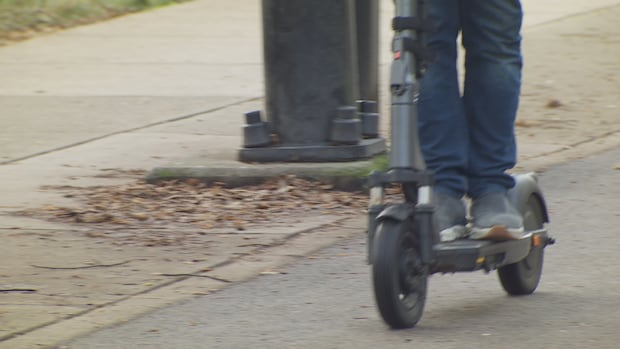
Similar to the Canadian Pediatric Society and the American Academy of Pediatrics, her organization advises against children under 16 operating these vehicles.
“These are not toys. While they can be enjoyable and have their place, they come with risks,” Fuselli remarked during an interview on CBC Radio’s The St. John’s Morning Show.
-
‘Exponential rise’: Canadian pediatricians document severe e-scooter injuries, deaths in children, teens
-
As N.L. eyes e-bike, e-scooter regulations, this vendor says safety is top of mind
Fuselli emphasized that a range of stakeholders, including manufacturers, lawmakers, and enforcement agencies, have roles to play in enhancing the safety of these devices.
“This combination is crucial for preventing injuries,” Fuselli noted.
Regulatory Shortcomings
Julia Kent, who oversees social responsibility and advocacy for the Canadian Automobile Association Atlantic, pointed out that the rapid adoption of these motorized vehicles is outpacing regulatory measures, with many areas lacking rules for what she refers to as “micro-mobility vehicles.”
“Regulatory bodies and governments simply cannot keep up. Emergency rooms are definitely feeling the effects,” Kent told CBC News.

Julia Kent of the Canadian Automobile Association believes that while implementing regulations will take time, it is achievable. (CBC)
She noted that injuries from these vehicles tend to be more serious than those from a typical bicycle accident due to their higher speeds.
“They pose a definite risk. They are a convenient and effective means of transportation, but they are not without danger,” Kent stated.
Some regions have introduced regulations concerning helmet use, speed limits, and permissible areas for operation, she explained. Although establishing regulations will take time, Kent remains optimistic about the possibility.
Download our free CBC News appto sign up for push alerts for CBC Newfoundland and Labrador. Sign up for our daily headlines newsletter here. Click here to visit our landing page.