

Both Kalshi and Polymarket were quick to highlight their successes on midterm election night, asserting that their predictions were largely accurate.
With billions wagered on these prediction markets, which enabled traders to place bets on candidate victories and control of the Senate and House, their precision became a focal point. Media outlets like CNN and MSNBC featured prediction market odds in their midterm election reporting, while artists such as YG and celebrities like Heidi Montag discussed their midterm wagers on election night.
As per Kalshi’s summary of the midterm elections, $2.5 billion US was traded on midterm markets, nearly doubling the $1.3 billion US recorded in the 2024 election cycle. Polymarket noted nearly $700 million US in bets placed during this election cycle across its U.S. and international platforms, as reported by Reuters.
Polymarket stated on X that the prediction-market venue was “correct” and asserted that “98.4 percent of resolved midterm races were won by the Polymarket favorite the day prior to Election Day.”
Kalshi echoed this sentiment, asserting that candidates favored on its platform won or were leading in 98 percent of races before polls closed on election day.
Valerie Cross, who leads emerging verticals at NEXTPredict.io, which observed Kalshi and Polymarket during the election night, noted that while those statistics aren’t necessarily inaccurate, “it’s easy to misinterpret.”
She added that the statistics demonstrate how prediction markets were capable of quickly integrating “early returns, exit polls, and county counts, and generally moved in the right direction.”
“They were also quick to indicate potential upsets, as raw vote counts can make a race appear closer than the odds suggest,” she commented.
Kalshi and Polymarket election prediction markets are seeing record trades ahead of the 2026 U.S. midterms. For The National, CBC’s Ashley Fraser explores how betting odds can influence American voters and if the platforms risk distorting public perception.
Predicting a blue tsunami
While the platforms were largely successful in predicting winners, they failed to foresee some of the most unexpected outcomes of the evening.
A study by Betting Intelligence analyzing over 400 races identified 14 upsets, all won by Democrats.
One notable upset occurred in the South Carolina Senate race, where prediction markets had favored Republican Darline Graham with a 70 percent chance of winning, only for Democrat Annie Andrews to claim an unexpected victory.
Further surprises included Democrat Gina Hinojosa’s triumph over incumbent Republican Gov. Greg Abbott in Texas, with markets giving Hinojosa a mere 40.1 percent chance the day before the election.
The analysis concluded that both polls and markets “equally identified the eventual winner, yet both underestimated Democratic candidates.”
David Szakyoni, co-founder of the Anti-Corruption Data Collective, which evaluates prediction markets based on publicly accessible data, noted that the markets “seem to respond to vote counts and polling data rather than offering something unique.”
Rajiv Sethi, an economist from Columbia University, remarked that neither polls nor prediction markets could have “predicted the magnitude” of Democratic victories on election night.
He referred to races where both polls and markets were inaccurate as a way to better comprehend their impact, such as the extremely close Mississippi Senate race.
(CBC)
As of Thursday afternoon, The Associated Press had not yet called the race, with Democrat Scott Colom leading Republican Sen. Cindy Hyde-Smith by 1,803 votes.
Neither the polls nor the markets anticipated the narrow margin between the two candidates, but Sethi pointed out that prediction markets offered Colom a slightly better opportunity than the polls indicated, highlighting their ability to respond to candidate errors or achievements during the campaign.
“[Polls] cannot capture the truly unique events that markets can. That is the markets’ strength,” he stated.
However, despite the markets’ rapid reactions, they still depend on polling data for their forecasts.
“The markets react to the models. Without the models, the markets would assess things very differently.”
Before the networks
Cross concurred that the markets shouldn’t always be directly compared to polls.
“They gauge different metrics at various times and are more interdependent than the headlines imply.”
She added, “For an early indication of likely winners on Election Day, nothing surpasses prediction markets.”
“Traders are integrating all the information available into their predictions,” Cross noted. “At 8:12 p.m., with around 31 percent counted in South Carolina, Andrews was leading 52 percent to 46 percent, while NBC stated it was too early to make a call.”
Polymarket CEO Shayne Copland mentioned on X, “It now takes hours for prediction markets to make calls compared to TV networks.”
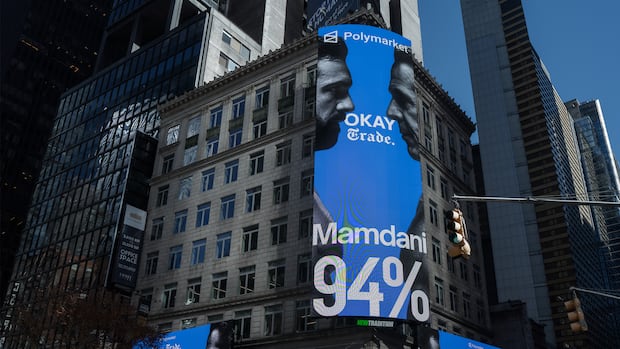
Prediction markets like Kalshi and Polymarket have exploded in popularity, processing billions in daily trades. For The National, CBC’s Nora Young breaks down how they work and why experts say it’s just another form of gambling that comes with risks of insider trading and manipulation.
Kalshi CEO Terek Mansour expressed a similar viewpoint, stating, “For decades, election night meant switching on the television and waiting for a select few to inform you of the results. Prediction markets alter that dynamic.”
According to Betting Intelligence, in most tightly contested races, prediction markets reached a 97 percent likelihood for the eventual winner approximately an hour prior to The Associated Press declaring the race. None of the candidates that achieved that probability lost.
Despite these timely predictions, Szakonyki expressed skepticism about whether prediction markets significantly contributed to the electoral discourse this cycle.
Cross, however, remarked that the substantial trading volume underscores a strong level of interest.
“Midterm elections typically garner a fraction of the attention that presidential elections do. If this midterm can generate such figures, the 2028 election could be exponentially larger.”