

Although the Cold War officially concluded many years ago, recent studies indicate that its impact continues to be felt in the vegetation of Gatineau Park.
For over 65 years, researchers have been gathering sugar maple leaves from the expansive park in western Quebec to investigate the presence of nuclear radiation.
Research spearheaded by Len Wassenaar reveals that these leaves contained remnants of radiocarbon dating back to the early Cold War period, with findings published recently in the journal Nature Scientific Reports until 2024.
Wassenaar serves as the executive director of the André E. Lalonde National Facility for Accelerator Mass Spectrometry at the University of Ottawa.
He appeared on CBC Radio’s Ottawa Morning last week to discuss his findings.
The following interview has been edited for brevity and clarity.

Len Wassenaar notes that until 2024, maple leaves in the park retained traces from nuclear tests conducted over 60 years ago. He is the executive director of the André E. Lalonde National Facility for Accelerator Mass Spectrometry.
What is the focus of your study regarding the leaves in Gatineau Park?
The investigation dates back to the 1960s when there was significant concern among scientists about nuclear fallout across the globe due to the arms race and hydrogen bomb tests.
In 1961, the Geological Survey of Canada initiated the collection of sugar maple leaves in Gatineau Park to analyze the impacts of atmospheric nuclear weapons testing.
What did the analysis of the leaves reveal?
In essence, the nuclear tests conducted in the 1950s and 1960s released substantial amounts of radioactive carbon-14 into the atmosphere.
Many may recall the images of mushroom clouds resulting from these detonations. The carbon reacted, leading to the formation of carbon dioxide, which quickly spread worldwide.
These detonations effectively doubled the levels of radiocarbon in the atmosphere, peaking around 1964. The trees absorbed this radiocarbon through carbon dioxide via their leaves.
Although nuclear testing largely ceased in 1980, this radiocarbon signature has persisted, with its presence officially concluding in May 2024 in the Ottawa area.

Visitors take photographs amidst the autumn colors at Pink Lake in Gatineau Park during Thanksgiving in Gatineau, Que., on Monday, Oct. 12, 2026. (Keito Newman/The Canadian Press)
So, by that time, there were no longer any detectable traces?
Correct. Two primary factors contributed to this.
Firstly, the carbon dioxide that contained bomb-related radiocarbon was absorbed by plants and oceans, effectively removing it from the atmosphere.
Secondly, the continued reliance on fossil fuels has diluted the amount of bomb-derived carbon in the atmosphere, as fossil fuels do not contain radiocarbon.
These two elements combined have reduced the levels to what we would classify as pre-nuclear testing levels. Currently, we are observing the ongoing effects of fossil fuel combustion, which are expected to persist into the future.
Is it positive that these radioactive traces are no longer found in the leaves?
Yes, indeed. It illustrates the enduring effects that nuclear activities can have over time, lasting for decades.
It is important to note that the levels of radiocarbon are exceedingly low, posing no risk to human health. These are trace amounts in parts per trillion, which are extremely minimal.
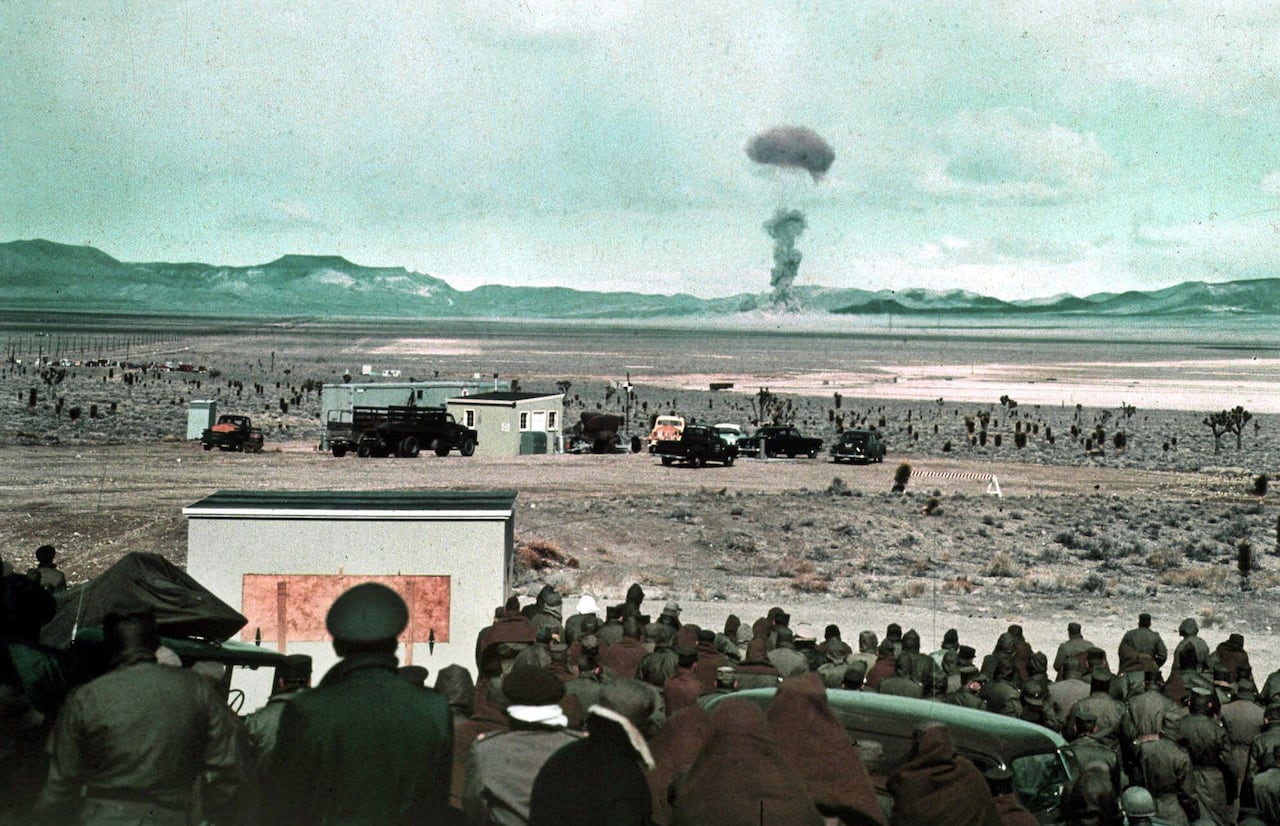
Military personnel observe a mushroom cloud resulting from the detonation of a 22-kiloton bomb known as Met, which exploded on April 15, 1955, at the Nevada Test Site near Las Vegas. (Associated Press)
How might these findings be valuable in a broader context?
Primarily, it highlights the enduring legacy of nuclear testing, which can remain detectable even 40 to 50 years later.
Additionally, it underscores the importance of long-term scientific research, as it took 65 years of observation to witness the conclusion of this phenomenon.
Looking ahead, as we continue to burn fossil fuels, if we were to cease or reduce their use, the current trend should reverse. This serves as a compelling example of how nature can document environmental impacts over extended periods, and it emphasizes the need for us to heed these observations.